// work/project incremental
Project Incremental
An idle game for phones. You build a particle factory, a moon does your shopping, tiny ships chew through a spaceship, and somewhere along the way you grow a planet out of dust. It isn't out yet, but every demo on this page runs on the game's real code, ported to your browser.
What you actually do
You start with one machine that makes Particles, the money. Then you buy a machine that makes those machines, then one that makes those, four levels deep. Every four seconds the whole thing moves one step, and the numbers start running away from you.
That's the first ten minutes. After that a Moon turns up and goes shopping for you, even while the game is closed. Fleets of tiny ships start chewing through enemy hulls. You reset your run for Cycle Points and spend them in the Orrery, a star map of 33 upgrades. And in the Nursery you grow an actual planet, from a cloud of dust to a ball of lava to solid ground. There's more after that, but it isn't finished, so it stays a secret for now.
A planet from a number
Here's the Nursery planet. The game has no picture of it. There are no art files in the game at all, apart from the font. Every pixel is calculated from four things: the era, how much mass you've gathered, which crust you picked, and one seed number.
Change the seed and you get a different world. Type the same seed again and you get the same world back, pixel for pixel, on any device, forever. Go on, try a few.
fingerprint …
The trick is that nothing is actually random. Each pixel runs its own coordinates and the seed through a hash, a common integer-hash recipe built on xxHash's primes, and gets the same answer every time. The light is textbook stuff: a light direction, a dot product, and darker edges so the ball looks round. Then every brightness gets snapped to a small palette, which is where the pixel-art look comes from.
Porting it to the browser broke in exactly one place. Godot stores colours as 32-bit floats and chops off the fraction when it writes a pixel, so the browser has to chop them the same way. Until it did, the glow in the middle of the dust cloud didn't match.
And the crust isn't the end. Later the planet grows an atmosphere, then a sea that rises one mark at a time, and then a second world turns up next to it.

250 small ships
The ships fight enemies drawn on a 64 by 64 grid. The first one is the First Remnant, a wobbly blob of 1,753 cells with three sealed rooms inside. Ships bite one cell at a time, and only from the outside, so the rooms stay safe until someone chews a way in.
The fun part is what happens when a bite cuts the hull in two. The piece that's still attached to the core stays, and the other piece breaks off and floats away as salvage. Send in a swarm, or skip the patience and use the scalpel.
- left
- 1,753
- eaten
- 0
- broke off
- 0
Only the glowing edge can be bitten. The blue cell is the core.
Then I tried 250 ships with three hours away. When you come back, the game replays every single bite exactly, and finding "where should this ship go next?" was eating 71% of the time, because each ship scanned the whole grid. An index brought each answer from 238 microseconds to about 18, and a three-hour replay went from 179.8 seconds to 52.8. That's on my desktop, though. Nobody has tried it on a phone yet, so the ships are still on a diet.
Things that fight back
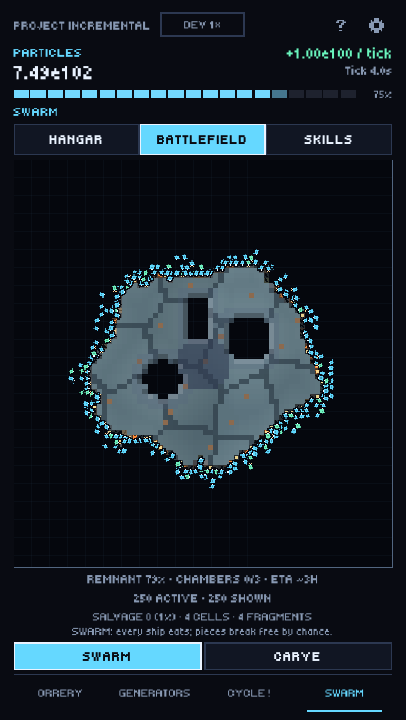
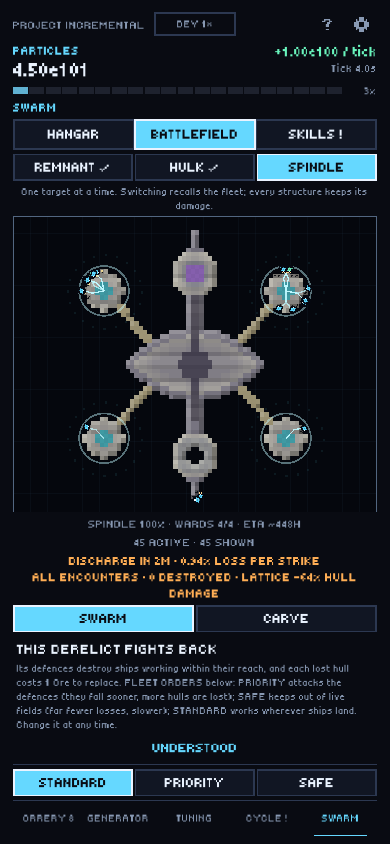
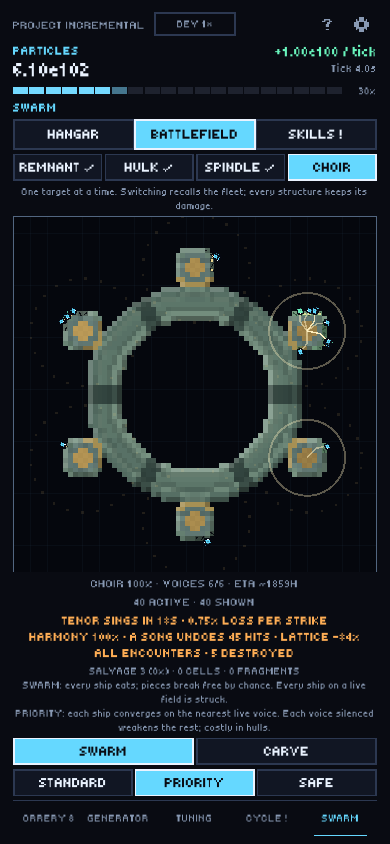
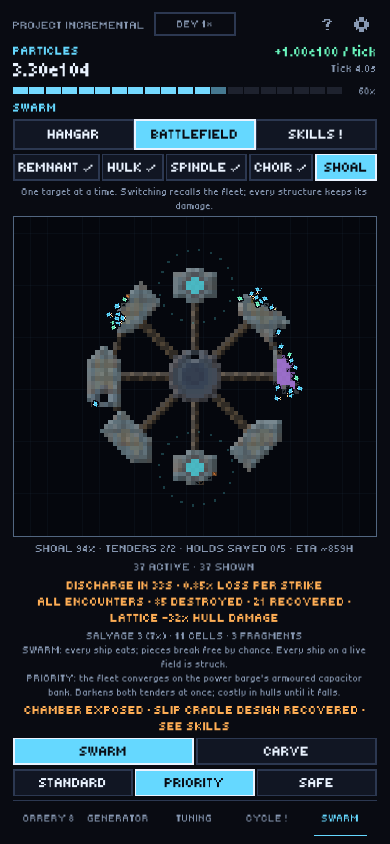
The First Remnant is the gentle one. It just sits there and lets you eat it. The derelicts after it don't. These are real screenshots from the game.
Your factory is a solar system
The first tab in the game isn't a menu. It's the Orrery, your factory drawn as a tiny pixel solar system. Every kind of generator you own gets its own tilted orbit, and every four seconds a pulse runs from the outside in and pops out of the core as a ring.
Buy your first Generator II and watch the whole thing zoom out to make room. Then hit Cycle Reset. The factory starts over, but the sky behind it keeps one star for every reset you've ever done, and none of them ever move.
0
CYCLE 1 · 0 RESETS
Two orbits so far. Try buying a Generator III.
Three hours in ten multiplications
Close the game for three hours and it owes you 2,700 ticks of factory. The obvious way to pay is to run the factory 2,700 times. The game doesn't. It answers in ten multiplications, and it would be the same ten for three years.
It works because the factory is secretly Pascal's triangle, the one from school where every number is the two above it added up. Count the ways a bit of production can trickle down four levels of machines in 2,700 ticks, and you get numbers straight out of row 2,700 of that triangle. So the game just looks them up. That trick was in the very first version of the game.
What you own
While you were away
0
Particles
Pick how long you were gone.
3.999999999999994
Eighty frames of 0.05 seconds is four seconds, one tick. Ask a computer to add them up and it says 3.999999999999994, so the tick never happens. The game fixes it with a nudge of one billionth of a second before checking. Press the button and watch your own browser get it wrong.
0
- frames
- 0
- ticks without the nudge
- 0
- ticks with it
- 0
It matters because an hour has to be the same hour whether you watch all of it or close the app and come back. The tests feed the game the same hour in different slices, in one go, a second at a time, in uneven frames, with a save and reload in the middle, and then compare the whole save file.
By the numbers
- 4levels of machines
- 4 sper tick
- 3 hof time away it pays out, or 4 with the right upgrade
- 33upgrades in the Orrery
- 264separate things in the game, and 224 of them playable today
- 4,096pixels in a planet
- 1,753cells in the First Remnant
- 4,493test checks, all passing
How it got made
It's made in Godot 4.7, for phones held upright. One rule from the start was no art files, so everything you see is drawn by code, except Tiny5, the pixel font on this page, which is free under the Open Font License. Every change also went into a development log with the reason for it, which is where most of this page comes from. Roughly in the order it got built:
- NumbersThe four-level factory and the triangle trick, both in the first version.
- MoonA moon that shops while you're away, and the half-orbit bug.
- FleetsShips, hulls and bites, then the work to make 250 ships fast enough.
- NurseryThe planet, from dust to crust and beyond.
- TestsAll along. By now there's more test code than game code.